
 Image 1 of 1
Ultra-Segmentation Guide
Not every customer wants the same product, responds to the same message, or buys for the same reason. When you market to everyone as one audience, you may overlook the differences that make your offers relevant.
Some customers purchase frequently. Others only shop during specific seasons. One group responds to educational content while another prefers direct product information. How do you identify those differences using the information you actually have? Which customer segments deserve different offers? And how can you personalize marketing without crossing privacy boundaries or creating unnecessary complexity?
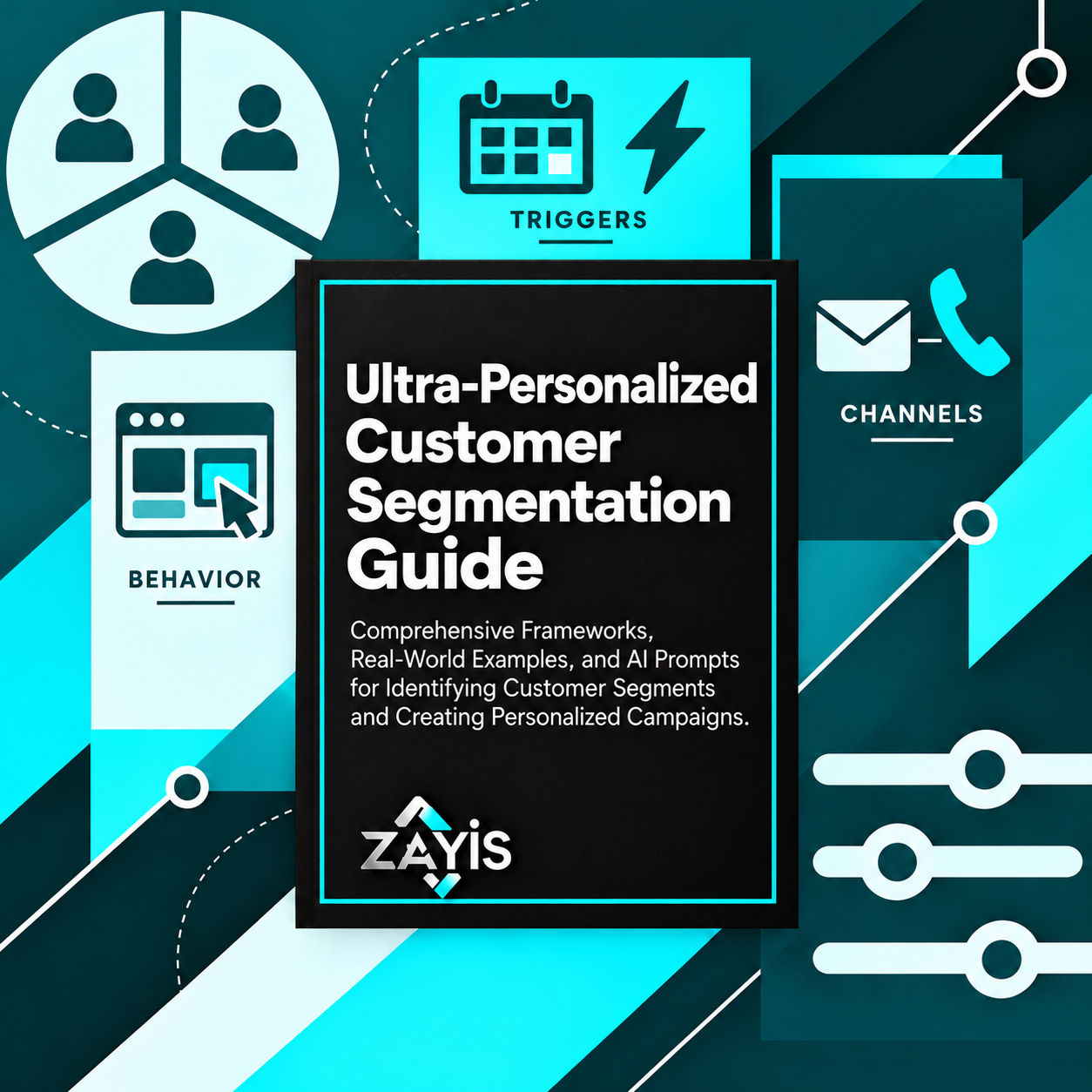
The Zayis Ultra-Personalized Customer Segmentation Guide helps you organize customers into more useful groups. Use practical frameworks and structured AI prompts to examine purchasing behavior, develop audience profiles, plan relevant campaigns, and evaluate whether personalization improves measurable outcomes.
What you can build:
Behavioral customer profiles: Organize customers using relevant purchase history, interactions, expressed interests, and other appropriately collected information.
A customer priorities and life-stage messaging map: Develop campaign concepts around customer-stated needs and circumstances without making unsupported personal assumptions.
A high-value customer engagement plan: Identify important customer relationships, evaluate their business contribution, and develop appropriate ways to improve service and retention.
An event-triggered communication system: Plan relevant messages around legitimate customer actions, purchasing milestones, and changes in expressed needs.
A seasonal customer segmentation calendar: Identify purchasing occasions, recurring demand patterns, and opportunities for more relevant seasonal communication.
A customer channel preference and messaging plan: Organize communication across email, website, and other approved channels while respecting preferences and avoiding duplicate messages.
A personalized offer and testing framework: Develop segment-specific offers, relevant upsell concepts, and controlled experiments to determine whether personalization provides meaningful value.
Put your AI assistant to work with a clearer brief.
Each strategy combines a practical customer segmentation framework, illustrative examples, copy-and-paste AI prompts, and implementation guidance. Instead of asking AI to personalize your marketing for everyone, you can define customer behaviors, qualifying criteria, communication permissions, campaign goals, and the information available for creating useful segments.
Upload the PDF to a compatible AI assistant, describe your business, customer groups, available data, and marketing objective, then work through one segmentation decision at a time. Use approved or appropriately anonymized information, distinguish observed behavior from inferred motivations, and validate campaign results before expanding.
What's included:
A 30-page PDF with 10 customer segmentation strategies.
A 90-day implementation plan.
A Segmentation Analysis & Action Worksheet.
A Segmentation Review & Next Move resource.
Frameworks for behavioral personas, life-stage targeting, and high-value customer programs.
Psychographic research and event-triggered segmentation strategies.
Seasonal buyer clustering and communication channel preference mapping.
A/B segmentation testing and micro-niche offer development.
Segmentation-driven upselling and campaign measurement guidance.
Illustrative examples, five-step implementation instructions, and a task-based section finder.
Sources and further reading.
Who it's for: E-commerce businesses, entrepreneurs, marketers, CRM professionals, subscription businesses, customer experience teams, and organizations seeking more relevant customer communication.
Don't send a different message simply because you can divide customers into groups. Understand which differences actually matter and use that knowledge to create more useful, respectful, and measurable marketing.