
 Image 1 of 1
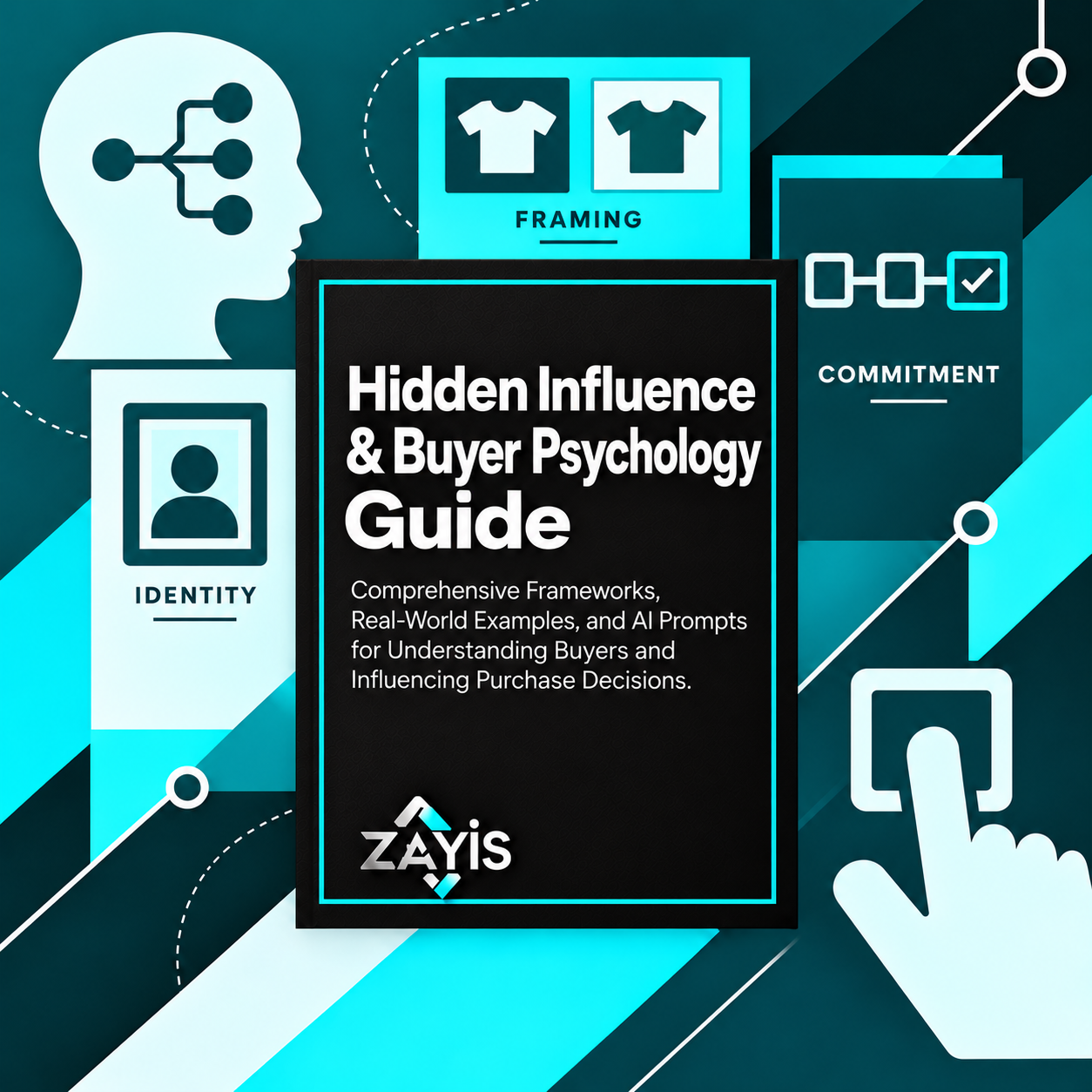
Hidden Influence Psychology Guide
Two customers can look at the same offer and reach different conclusions. Price, credibility, perceived risk, identity, and even the order of information can influence what they choose. Understand the psychology behind those decisions instead of relying on guesswork.
You have a product worth considering, but customers hesitate. Some compare your prices against alternatives. Others question whether the offer is credible. A few respond to your marketing, but most leave without purchasing. What influences those decisions? Which parts of your presentation deserve testing? And how do you make your offer easier to evaluate without resorting to manipulation?
The Zayis Hidden Influence & Buyer Psychology Guide helps you apply behavioral marketing principles to practical business decisions. Use structured AI prompts, worked examples, and research-backed frameworks to develop clearer offers, examine purchasing hesitation, and test persuasive communication strategies.
What you can build:
A pricing anchor and offer comparison: Create pricing tables that explain differences between packages and help customers evaluate the value of each option.
An ethical urgency campaign: Develop messaging around genuine deadlines, limited availability, or other verified constraints without manufacturing pressure.
A checkout hesitation improvement plan: Identify possible purchasing concerns and test messages that communicate relevant benefits, risks, and next steps.
An identity-focused advertising concept: Develop messages that reflect the goals and values of your intended audience while avoiding unsupported personal assumptions.
A decoy pricing experiment: Evaluate how a legitimate third option changes the presentation of your offer and what that comparison reveals about customer choices.
A credibility and social proof plan: Organize authentic testimonials, relevant qualifications, customer evidence, and trust signals that support your marketing claims.
A behavioral marketing testing system: Define hypotheses, compare messaging alternatives, document campaign results, and determine which changes deserve further attention.
Put your AI assistant to work with a clearer brief.
Each of the ten strategies combines an explanation of the psychological mechanism, a worked example, a copy-and-paste prompt, practical frameworks, and implementation guidance. Rather than asking AI to make your offer psychologically irresistible, you can develop specific pricing comparisons, messages, email sequences, and experiments grounded in real business information.
Upload the PDF to a compatible AI assistant, provide your product details, customer concerns, pricing structure, and marketing objectives, then work through one behavioral concept at a time. Verify claims and measure actual results rather than assuming a technique will improve sales.
What's included:
A 33-page PDF with 10 buyer psychology strategies.
A 90-day rollout plan.
A Buyer Psychology Audit Worksheet.
A Test Log for documenting experiments and findings.
Behavioral frameworks covering anchoring, scarcity, loss aversion, identity, decoy pricing, and social proof.
Reciprocity-based email, advertising framing, credibility, and commitment strategies.
Worked pricing tables, marketing copy examples, and measurable campaign scenarios.
Guidance on responsible persuasion and reliable marketing tests.
A task-based section finder, sources, and verification notes.
Who it's for: E-commerce sellers, entrepreneurs, digital marketers, pricing strategists, sales professionals, and business owners interested in consumer decision-making.
Don't rely on psychological tricks to force a sale. Understand how buyers evaluate value, build offers that hold up to scrutiny, and test what helps customers make confident decisions.