
 Image 1 of 1
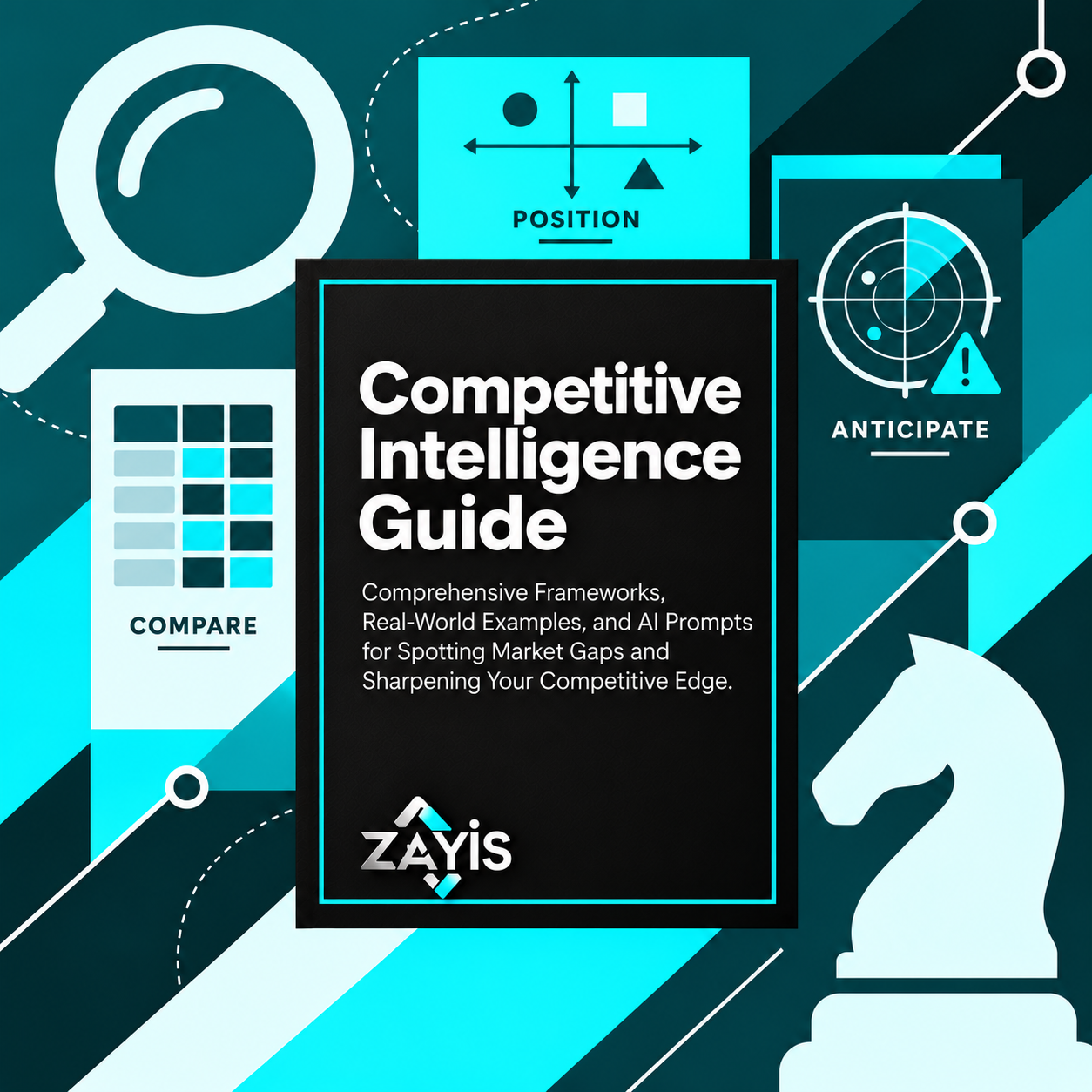
Competitive Intelligence Guide
Your competitors are showing you their prices, products, marketing strategies, and positioning. The information is available. The advantage comes from knowing what to examine and what to do with it.
You're entering a market or trying to improve your position in one. Who are customers comparing you against? Which features do those businesses emphasize? What are customers complaining about? And where could your business offer something meaningfully different?
The Zayis Competitive Intelligence Guide helps you investigate those questions systematically. Use practical research frameworks and structured AI prompts to compare competitors, identify potential opportunities, and develop strategic decisions supported by evidence.
What you can build:
A competitor feature comparison matrix: Evaluate competing products across the capabilities customers care about, distinguishing meaningful differences from unverified claims.
A competitive pricing tracker: Compare products, packages, billing terms, limitations, and value propositions using equivalent offers wherever possible.
A product positioning map: Visualize where competing businesses sit in the market and explore opportunities for clearer differentiation.
A competitor advertising and content audit: Examine promotional messages, campaign angles, customer questions, and gaps in existing content.
A customer sentiment analysis: Organize recurring praise, complaints, unmet needs, and potential reasons customers consider switching providers.
An emerging competitor threat radar: Identify developing alternatives, substitute products, market changes, and signals that deserve further investigation.
A competitive action plan: Combine research findings, evidence quality, and business priorities to decide what to build, emphasize, test, or stop pursuing.
Put your AI assistant to work with a clearer brief.
Each strategy combines a research framework, illustrative example, copy-and-paste prompt, and implementation guidance. Rather than asking AI to "analyze my competition" and accepting a generic summary, you'll have defined research questions, comparison criteria, evidence requirements, and decision-focused outputs.
Upload the PDF to a compatible AI assistant, identify your business, competitors, target customers, and market, and work through one competitive research objective at a time. Use verifiable sources and distinguish confirmed findings from estimates and assumptions.
What's included:
A 28-page PDF with 10 competitive intelligence frameworks.
A 90-day implementation plan.
An Intelligence Analysis and Action Worksheet.
A Competitive Action Review and Next Move resource.
Frameworks for competitor comparisons, market share research, SWOT analysis, positioning, pricing, content audits, and emerging threat monitoring.
Illustrative business scenarios and evidence-based implementation guidance.
A section finder, sources, and further reading.
Who it's for: Entrepreneurs, startup founders, business strategists, product developers, marketers, consultants, and established businesses seeking to understand their competitive position.
Don't build your next business move around assumptions about the competition. Research the market, identify the evidence, and decide where your business has a credible opportunity to stand apart.