
 Image 1 of 1
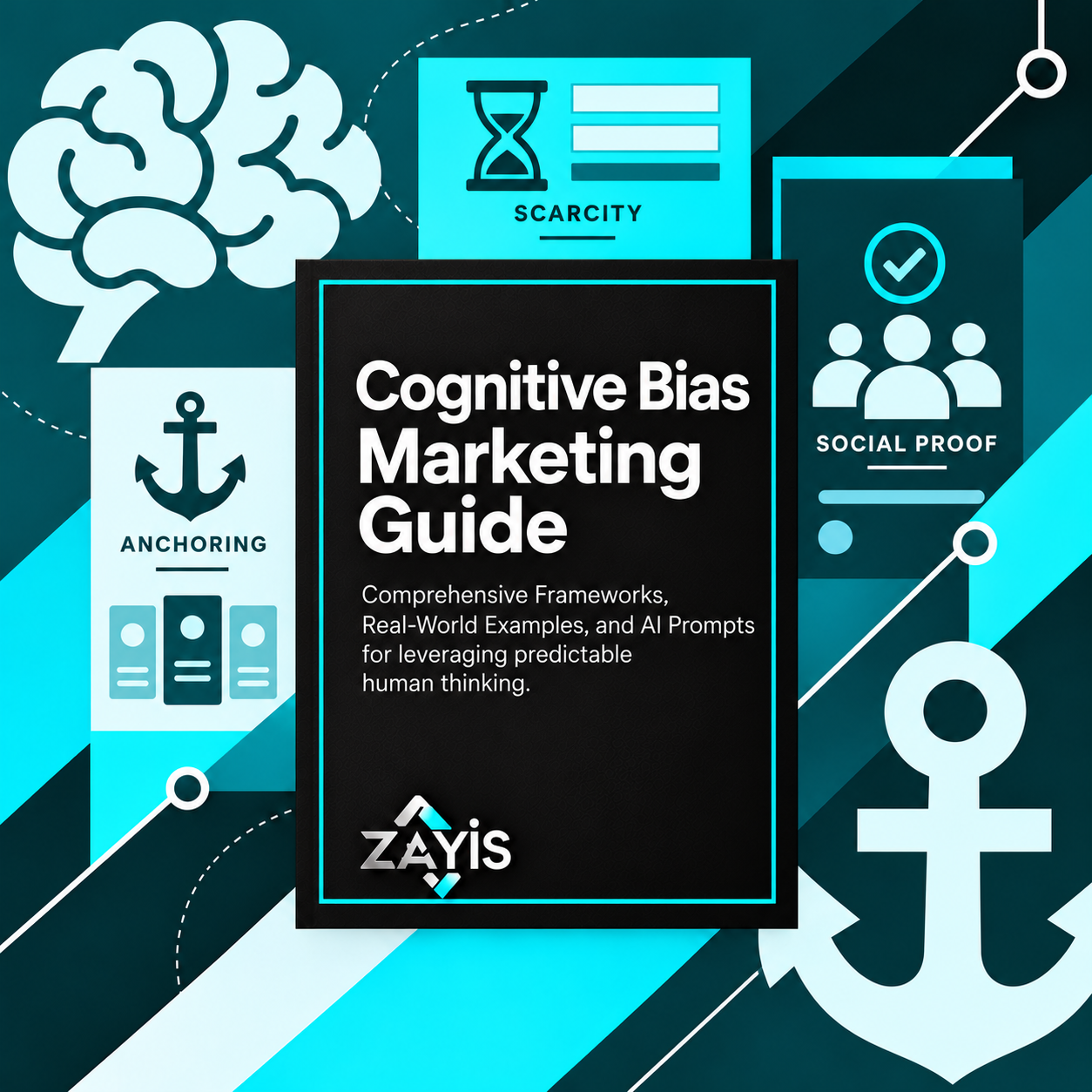
Cognitive Bias Marketing Guide
Customers don't always choose the best offer on paper. They choose based on what they notice, understand, trust, and believe is worth their money. Learn how the presentation of value influences the decision.
You may have a competitive product, reasonable pricing, and a genuine solution. But are customers comparing your offers correctly? Do they recognize the differences between your packages? Does your marketing give them enough evidence to feel confident purchasing?
The Zayis Cognitive Bias Marketing Guide helps you examine those questions through behavioral psychology. Use structured AI prompts and practical marketing frameworks to develop clearer offers, investigate purchasing hesitation, and test how customers respond to different presentations.
What you can build:
A pricing and anchoring comparison: Present premium and standard offers with clearly defined differences, helping customers understand what each option provides.
An ethical scarcity campaign: Communicate genuine deadlines, inventory limitations, or availability constraints without inventing pressure.
A loss-aversion messaging experiment: Explore how to communicate the practical cost of delaying a decision while keeping claims accurate and proportionate.
A social proof and credibility plan: Identify relevant customer evidence, testimonials, qualifications, and authority signals that support your offer.
A product framing experiment: Compare alternative presentations of the same product or service to see which helps customers understand its value.
A decoy-effect offer comparison: Examine whether a genuinely available third option changes how customers evaluate your pricing structure.
A behavioral marketing test plan: Establish hypotheses, meaningful performance metrics, and review criteria before applying psychological principles to a campaign.
Put your AI assistant to work with a clearer brief.
Each strategy combines a behavioral framework, illustrative business example, copy-and-paste AI prompt, and implementation guidance. Instead of asking AI to "make my offer irresistible," you'll have a structured method for evaluating customer decisions, communicating real value, and designing marketing tests.
Upload the PDF to a compatible AI assistant, provide your actual offers, prices, audience, and customer objections, and work through one purchasing challenge at a time. Treat behavioral techniques as hypotheses to test, not guaranteed methods of increasing sales.
What's included:
A 26-page PDF with 10 cognitive bias marketing frameworks.
A 90-day implementation plan.
A Campaign Analysis and Action Worksheet.
A Campaign Review and Next Move resource.
Strategies covering anchoring, scarcity, loss aversion, social proof, authority, commitment, framing, the decoy effect, reciprocity, and the halo effect.
Illustrative examples, implementation guidance, and a task-based section finder.
Sources and further reading.
Who it's for: Entrepreneurs, e-commerce sellers, marketers, sales professionals, pricing strategists, and business owners interested in ethical behavioral marketing.
You don't always need to change what you're selling. Sometimes you need to help customers understand its value, compare their options, and make a more informed decision.